

There was a time when sitting with one idea for hours felt normal. You could read, think, pause, and actually process what you were consuming. Now, even a few uninterrupted minutes can feel like a stretch. You open one app, then another, then another, and suddenly your attention is everywhere but nowhere at the same time.
I started noticing this shift in small ways. Shorter focus, quicker reactions, less patience for anything that didn’t immediately engage me. It’s not just a habit change it’s a thinking pattern change. Technology hasn’t just made things faster. It has reshaped how the brain prefers to operate.
The Rise of “Popcorn Brain” and Fragmented Attention

One of the most visible changes today is what many describe as popcorn brain. Your thoughts jump rapidly, just like the content you consume.
With constant screen exposure, the brain adapts to fast-paced input. Instead of focusing deeply, it learns to expect quick bursts of information. Studies suggest that sustained attention has dropped significantly, with many people struggling to stay focused on a single task for more than a few minutes.
This leads to what’s often called “continuous partial attention.” You’re always engaged, but never fully focused.
The deeper issue isn’t distraction, it’s adaptation. Your brain is rewiring itself to match the speed of digital content.
From Deep Thinking to Surface-Level Processing
Technology has shifted thinking from depth to speed.
Instead of reading thoroughly, people scan. Instead of analyzing, they react. Short-form content videos, quick posts, endless feeds train the brain to prioritize speed over understanding.
Another subtle loss here is boredom. It used to be a natural mental state where creativity emerged. Now, every idle moment gets filled with content. Without that pause, the brain loses opportunities to reflect, connect ideas, and think independently.
Over time, this creates a habit of shallow processing. You consume more, but understand less.
Cognitive Offloading and AI Dependence

One of the most powerful changes is how we use memory.
Instead of storing information, we rely on tools to retrieve it. This is known as cognitive offloading. The brain prioritizes knowing where to find information rather than remembering it.
This pattern has intensified with AI. When answers are generated instantly, the brain skips the effort of reasoning. It becomes efficient but less engaged.
This is closely tied to systems like Data-Driven Decision Systems, where decisions are increasingly guided by data models rather than human judgment. While this improves speed and accuracy, it also shifts thinking away from intuition and independent analysis.
Another consequence is passive acceptance. Algorithms feed you content based on your past behavior, reinforcing existing beliefs instead of challenging them. Over time, this reduces critical thinking and creates a narrow perspective.
Dopamine Loops and the Need for Instant Reward
Modern platforms are built around engagement, and engagement is driven by reward.
Every scroll, like, or notification triggers a small dopamine response. This creates a feedback loop: consume, reward, repeat.
The problem is not the reward itself, but the expectation it creates.
Your brain starts preferring:
- Quick stimulation
- Immediate results
- Constant novelty
As a result, slower activities like deep work or problem-solving start to feel uncomfortable. Not because they are difficult, but because they don’t provide instant feedback.
This reduces mental endurance. The ability to stay with a complex idea or work through a challenging problem weakens over time.
Multitasking and the Illusion of Productivity

Technology has normalized multitasking. Switching between apps, tabs, and tasks feels productive, but it comes at a cost.
Each switch disrupts focus. The brain needs time to re-engage, which leads to cognitive fatigue and more errors.
Heavy multitaskers often struggle more with filtering distractions and maintaining concentration. What feels like efficiency is actually fragmented thinking.
There’s also an impact on memory. Constant reliance on navigation tools, for example, reduces spatial memory. You reach places without truly understanding the route.
This reflects a broader trend of technology replacing internal cognitive effort.
Algorithms, Personalization, and Filtered Thinking
Algorithms don’t just show content, they shape perception.
They learn your preferences, behaviors, and even emotional triggers. Over time, they create highly personalized feeds that keep you engaged.
But personalization comes with a trade-off.
You see more of what you already agree with and less of what challenges you. This creates filter bubbles, where thinking becomes reinforced rather than expanded.
The constant connectivity enabled by the evolution of Wireless Technology has accelerated this effect. Information flows continuously, leaving little room for reflection.
You don’t just consume faster, you think faster, often without questioning.
Generational Shifts and Mental Impact

Younger generations, especially those exposed to short-form content early, are experiencing noticeable cognitive changes.
There are signs of:
- Reduced attention span
- Lower working memory capacity
- Increased dependence on external tools
At the same time, there’s a rise in what people describe as “mental fog.” Constant content consumption, especially doomscrolling, leads to anxiety, reduced clarity, and disrupted sleep patterns.
This doesn’t mean technology is harmful by default. It means its impact depends on how it’s used.
The Trade-Off: Speed, Efficiency, and Depth
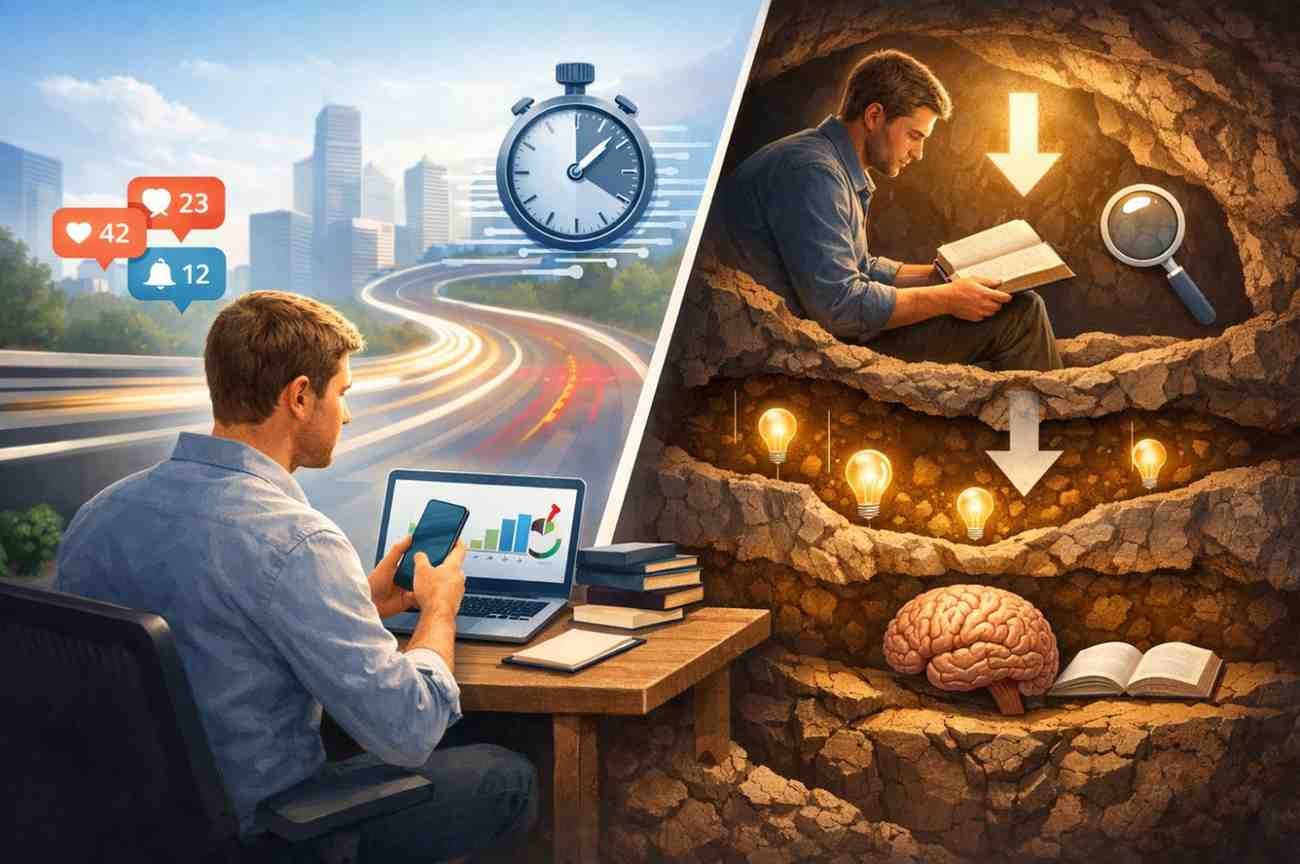
Technology has improved certain cognitive abilities while weakening others.
Here’s how that trade-off looks:
- Faster information processing
- Better visual-spatial skills
- Improved adaptability
But at the cost of:
- Deep focus
- Long-term memory
- Independent critical thinking
The brain is not declining; it’s adapting. The question is whether that adaptation aligns with the kind of thinking you actually need.
FAQs: How Tech Changes Thinking Patterns in the Age of Algorithms and Short Attention
1. How do tech changes affect thinking patterns in daily life?
It shifts thinking toward faster processing, shorter attention spans, and increased reliance on digital tools for memory and decision-making.
2. What is “popcorn brain” caused by technology?
It refers to a state of fragmented thinking caused by constant exposure to fast-paced digital content, leading to difficulty in maintaining focus.
3. Does AI reduce critical thinking?
Frequent reliance on AI for answers can reduce the effort spent on independent reasoning, which may weaken analytical thinking over time.
4. Can technology improve thinking abilities?
Yes, it can improve speed, multitasking in certain contexts, and visual processing, but often at the expense of depth and focus.
Closing Perspective
Technology has not taken away our ability to think; it has reshaped how thinking works. The shift toward speed, convenience, and constant stimulation has made life more efficient, but it has also made deep, focused thought less natural.
The real challenge isn’t avoiding technology. It’s learning how to use it without letting it define your thinking patterns.
Because the more seamlessly technology integrates into your life, the more quietly it begins to shape your mind.